Report: Would You Trust an Artificial Pancreas? The Role of Communication in Digital Health
15. July 2026
Symposium: Would You Trust an Artificial Pancreas? The Role of Communication in Digital Health
On 8 June, the Digital Society Initiative (DSI) at the University of Zurich hosted the symposium Would You Trust an Artificial Pancreas? The Role of Communication in Digital Health, funded by the DSI Health Community.
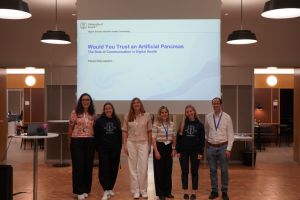
The symposium brought together four international speakers and about 25 participants from academia, healthcare, and the diabetes community to explore the central question of the event: How does communication shape trust in digital health technologies, and how are these dynamics challenged, complicated, and refracted through the lived experience of using an artificial pancreas?
The event was organised by Clara-Maria Barth and Federica Zavattaro. Clara-Maria Barth is a PhD candidate in computer science whose research focuses on the lived experience of the complex technological ecosystem surrounding life with type 1 diabetes. Federica Zavattaro is a PhD candidate in Digital and Mobile Health whose research examines trust in health data-sharing policy processes.
The symposium opened with an introduction by the organisers, who framed the discussion by highlighting the connections between trust, communication, digital health, and lived experience with chronic conditions. This set the stage for the four invited speakers, offering complementary perspectives on the topic:
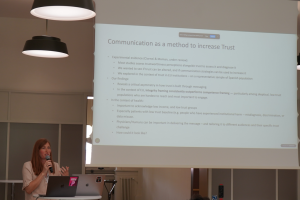
Dr. Libby Maman, a postdoctoral researcher and founder based in Barcelona, presented theoretical and empirical perspectives on institutional trust. Drawing on the ABI Model of Trustworthiness (Ability, Benevolence, and Integrity), she highlighted how different audiences weigh these dimensions differently when assessing the trustworthiness of digital health solutions.
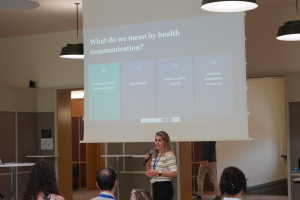
Clara Häfliger, a PhD candidate at the Swiss Paraplegic Research Centre, University of Lucerne, explored the role of communication in chronic care. She highlighted how health communication operates across multiple interconnected levels, from patient–provider interactions to interprofessional, institutional, public health, and inter-institutional communication. She concluded that trust in digital health depends less on the technology itself than on whether the communication surrounding it makes people feel accompanied, supported, and seen.
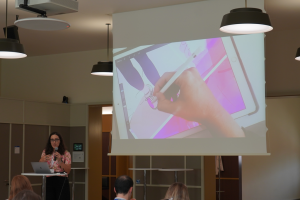
Janina Gaudin, a comic designer and visual artist from New Zealand, challenged our understanding of health communication through graphic medicine. Drawing on her work with the WHO and her lived experience of type 1 diabetes, she showed how visual metaphors, characters, and humor can help explain the complexity, emotional burden, and everyday realities of living with diabetes. She also sensitized us towards how words and imagery used to communicate about diabetes may reinforce stigma.
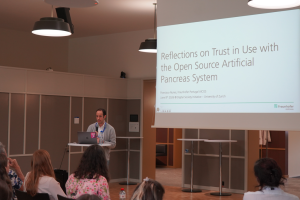
Dr. Francisco Nunes, senior researcher at Fraunhofer AICOS in Portugal, examined the development and everyday use of OpenAPS, an open-source artificial pancreas. Through examples from users and caregivers, he showed how transparency, technical understanding, personalization, and repeated experience can foster trust. In this context, trust is a pragmatic response to systems that users may consider imperfect but still more responsive to their needs than commercially available technologies.
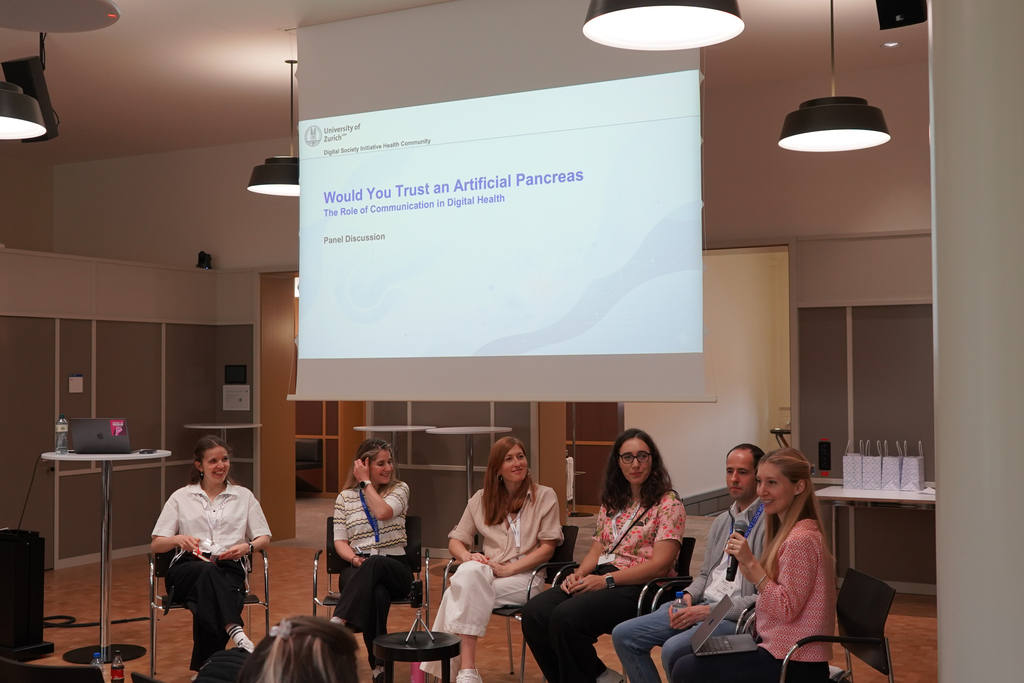
Following a networking break, participants engaged in an interactive panel discussion involving the speakers, organizers, and audience. The discussion explored the role of trust in the adoption of digital health technologies, the importance of effective communication, the opportunities and challenges posed by artificial intelligence, the role of trusted messengers, and priorities for future research. The diversity of perspectives, from academic research to lived experience, generated a rich and engaging dialogue.
The symposium concluded with an apéro, providing participants with the opportunity to continue the conversation in an informal setting, exchange ideas, and establish new connections for future collaboration.
The organisers would like to express their sincere thanks to all speakers and participants for their valuable contributions, thoughtful discussions, and enthusiastic engagement throughout the symposium.